Here's where we open the book and start reading, searching for different types of key words. We have several options, naturally.
Chronologically, for example: by the first mention of a measurement of time that appears in the book. And there are many of those. Day, night, morning, evening, and more specific hours. Months and seasons, years or simply ”it was a long time ago”. I'd be curious to see if there are patterns – if certain genres or authors tend to begin their books at night, for example.
Another option is to search for the first name mentioned, and order alphabetically by them. Complicated by books with no names in them, but they are quite few, after all. One could also search for the first geographical name or word, or perhaps by the first colour mentioned. I'm sure imagination sets the only boundaries.
Visar inlägg med etikett Systems I might try. Visa alla inlägg
Visar inlägg med etikett Systems I might try. Visa alla inlägg
måndag 29 augusti 2011

By subject
Well. This system gives almost endless opportunities – and endless difficulties. First you would have to decide: which subjects? This would of course depend upon your selection of books. For example, some people could fill shelves with novels about fish, or swords, or sculpting, or cars, or pyramids, or 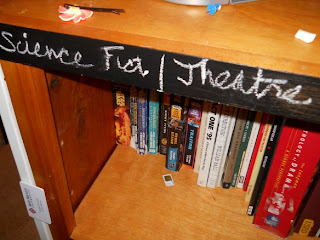 theatres, or ghosts, or baking. Others would need to divide their novels about vampires in Louisiana into subcategories. But even when you've gotten that far, the work is far from done. Because a couple of your novels about fish will also be about sculpting, and some of your books that have a lot of good things to say about cars will also have a point or two about pyramids. To be quite thorough, you will need to make a catalogue, fully cross-referenced. And, obviously, lables for the shelves. But little things like that have never stopped you before, have they?
 theatres, or ghosts, or baking. Others would need to divide their novels about vampires in Louisiana into subcategories. But even when you've gotten that far, the work is far from done. Because a couple of your novels about fish will also be about sculpting, and some of your books that have a lot of good things to say about cars will also have a point or two about pyramids. To be quite thorough, you will need to make a catalogue, fully cross-referenced. And, obviously, lables for the shelves. But little things like that have never stopped you before, have they?
Rhyming order
In Alphabetically by title, I suggested you could make it more fun by doing it backwards - i.e. by the last letters in the title. And from that, of course, there's only a skip, jump and stumble to organizing by rhyme.
Shades of Grey with Remains of the Day. The Subtle Knife with Nightlife. The Long Good-Bye with The Moor's Last Sigh. The Fifth Elephant with Valiant. By The Mountain Bound with Move Underground. The Onion Girl and The Windup Girl and The Icarus Girl. The City & The City with Freedom and Necessity... perhaps? Not a perfect rhyme, is it. And it will only get worse. This imperfect system will have many, many imperfections. The many forced rhymes will make you feel like a very poor poet indeed – and I'm also afraid to try it because I fear I would buy books just because they rhyme with books I already own.
I should point out, perhaps, that I'm not the only one who has come up with this insane idea. In The Library at Night (I read it in Swedish, Nattens bibliotek), Alberto Manguel describes China's imperial libraries in the first century CE. There the books were organized 1) graphically, and 2) by the rhyme in the last syllable in the last word of the title. Possibly, it's easier in Chinese? (Mandarin? What was the imperial language 2,000 years ago?) But it would be fun to try, wouldn't it?
söndag 28 augusti 2011
Geographically
If you want to organize your books geographically, I suppose there are two basic versions: By the author's country of origin, or by the country in which the book is set. Both face the same problem: neither authors nor fictional characters necessarily tend to be born, grow up, work and die in one country only. But that's the challenge, isn't it?
Of course, you could have one shelf for the single-country authors or books, one for the two-countries ones, and so on and so on upwards to the true globetrotters. You could have all kinds of sophisticated systems which cross-reference authors' birthplaces, residences and settings. You could end up drawing three- or four-dimensional maps with pins and lines all over to keep track. Maybe, just maybe, you should have a bookshelf shaped like a globe.
If I were to do this, I'd probably go for ordering by the countries in which the books are set. With suborders for London, Värmland, Mississippi/N'awlins, et cetera, of course. I'd probably have to draw a line somewhere along the lines of one-country, two-countries, three-countries, up to five or so, and then just "books set in more than five countries".
And then, of course, there's the question of: what is a country?
 Map from Dan Meth's Popculturalcharts.
onsdag 28 juli 2010
By authors' relationships
By author - but organized based on the relationships between the authors. A sort of six degrees of separation pattern. (I wonder who would be the centre, the Kevin Bacon? In my bookshelf, Neil Gaiman is naturally in the centre, because the Absolute editions w/ bookends have to be on the sturdy middle shelf. But probably someone like Shakespeare would be an excellent nexus... or in my case, perhaps Lord Byron.)
Some examples: Siri Hustvedt with Paul Auster and Moa Martinson with Harry Martinson are obvious choices. Emma Bull and Elizabeth Bear and Ellen Kushner are friends, and they are in turn friends with heaps of other excellent writers. But there are also connexions such as: obviously Stephen Fry should stand next to Oscar Wilde.
Like many other systems, this would probably grow to require a shelf in at least three dimensions. And/or it could probably be combined with an intertextual system.

Some examples: Siri Hustvedt with Paul Auster and Moa Martinson with Harry Martinson are obvious choices. Emma Bull and Elizabeth Bear and Ellen Kushner are friends,
 and they are in turn friends with heaps of other excellent writers. But there are also connexions such as: obviously Stephen Fry should stand next to Oscar Wilde.
Like many other systems, this would probably grow to require a shelf in at least three dimensions. And/or it could probably be combined with an intertextual system.
tisdag 29 juni 2010
By genre
It looks easy at first glance. Sure, fantasy there, science fiction there, crime there, mainstream there. But it isn't easy.
*Yes, I like to complicate things. Welcome to my blog ;)
First: whose definitions? Is it horror just because it has vampires? Is it crime just because someone is murdered? Is it fantasy just because there is something not rationally explicable - and is it a realistic novel just because there are no dragons?
Second: How wide or narrow definitions of genres? Subgenres is a wonderful jungle to explore. There's urban fantasy, but there's also paranormal investigators, paranormal romance, and fantzy (a.k.a. kick-ass chick-lit urban fantasy). There's alternate history, but then there's e.g. steampunk, and branching off from that, bustle punk and dieselpunk.
Of course, there are genres in mainstream as well, let's not forget. A friend of mine, Guru Wonganamapetilapilo, brilliantly invented the genre "Big books with dubious content". Ulysses is a perfect example of this genre, and I add authors like Thomas Pynchon and Georges Perec (all favourites. In fact, the genre is a favourite of mine). This can be completed with the genre "Small books with dubious content". Then there's the genre with the Swedish name "akaporr" - academia porn. E.g. The Secret History. Other mainstream genres could be "boyhood", "girlhood", "family novels spanning three generations", "small town books", "man pondering the world with himself as beginning and end", and so on and so on.
Every book fits into at least one genre. And that's another complication - complication in a good way, of course - the genre-mixing and genre-reinventing books.
I think this system would need to be associative. A chain of similar sub-subgenres. Could be fun! And then you could make a map. Like the one of Fiction Island in One of our Thursdays is Missing by Jasper Fforde.

*Yes, I like to complicate things. Welcome to my blog ;)
First: whose definitions? Is it horror just because it has vampires? Is it crime just because someone is murdered?
 Is it fantasy just because there is something not rationally explicable - and is it a realistic novel just because there are no dragons?
Second: How wide or narrow definitions of genres? Subgenres is a wonderful jungle to explore. There's urban fantasy, but there's also paranormal investigators, paranormal romance, and fantzy (a.k.a. kick-ass chick-lit urban fantasy). There's alternate history, but then there's e.g. steampunk, and branching off from that, bustle punk and dieselpunk.
Of course, there are genres in mainstream as well, let's not forget. A friend of mine, Guru Wonganamapetilapilo, brilliantly invented the genre "Big books with dubious content". Ulysses is a perfect example of this genre, and I add authors like Thomas Pynchon and Georges Perec (all favourites. In fact, the genre is a favourite of mine). This can be completed with the genre "Small books with dubious content".
 Then there's the genre with the Swedish name "akaporr" - academia porn. E.g. The Secret History. Other mainstream genres could be "boyhood", "girlhood", "family novels spanning three generations", "small town books", "man pondering the world with himself as beginning and end", and so on and so on.
Every book fits into at least one genre. And that's another complication - complication in a good way, of course - the genre-mixing and genre-reinventing books.
I think this system would need to be associative. A chain of similar sub-subgenres. Could be fun! And then you could make a map. Like the one of Fiction Island in One of our Thursdays is Missing by Jasper Fforde.

söndag 27 juni 2010
Alphabetically by protagonist
How about organizing your novels alphabetically ... not by the author's name but by the name of the main character?
Several brain teasers involved in this. First name vs. last name vs. nicknames/appellations/epithets is only the simple tip of the iceberg.
Books where the main character is never named would get a shelf of their own. These should probably be divided into first-person and third-person narratives; after all, "I" is a name of sorts.
More difficult are the books with several main characters. If you choose Leopold Bloom over Stephen Dedalus, Stephen will be offended, not to mention what Molly will think of you. And if you choose Ned Stark, Jaime Lannister will laugh at you. And so on.
And then, there are the books where the main characters have several names (Sandman - under S or M? Or K?).
Of course, simple systems are not what we are here for. So I might try this some time. Or at least begin to try it, and see whether the difficulties are over-comeable or maddening.
I can't remember if I dreamed this system up myself or if it was suggested to me ... So I tag it both ways ;)
Subjectively/arbitrarily quote-based sort-of serial order
Here's an idea I once thought I might try:
It begins like this: I have these notebooks, where I write down quotes I like from books I like. I should actually say, I used to write down quotes, because I never seem to find the time anymore. I even made an index in the notebooks (yes, I am an insane librarian) - an index which listed the title + the number of pages in the notebook filled with quotes from this book.
While I did this, I thought I might use these notebooks as a key for organizing my shelves. Like this:
First book quoted sits first on the shelf. Second book quoted sits second on the shelf. And - and this is the genius or insanity of it - if the quotes from a book take up say five pages in the notebook, the quoted book should be first in a group of five books, which ... have some sort of logical or associative connexion with the quoted book.
Are you following? (Btw, I like that spelling of 'connexion'.)
 An example: The quotes from The Name of the Rose take up 3 pages in the notebook. Hence, I would put The Name of the Rose in its place after the previously quoted book, and next to it I would place two related books. Related how, you ask? I dunno. Other Eco books? Other novels centered round libraries? Other mysteries solved by monks?
It would have been interesting to find out, wouldn't it? But the system falls on at least two factors:
* I haven't written down quotes in the notebooks for ages. As I say, I can't seem to find the time.
* I don't own most of the books I've quoted in the notebooks. I was an avid library patron in those days (now I want to own! my books), and most of the quoted tomes are back in Hc, Hce and He shelves in libraries around Sweden. I don't even own The Name of the Rose, in point of fact...
It begins like this: I have these notebooks, where I write down quotes I like from books I like. I should actually say, I used to write down quotes, because I never seem to find the time anymore. I even made an index in the notebooks (yes, I am an insane librarian) - an index which listed the title + the number of pages in the notebook filled with quotes from this book.
While I did this, I thought I might use these notebooks as a key for organizing my shelves. Like this:
First book quoted sits first on the shelf. Second book quoted sits second on the shelf. And - and this is the genius or insanity of it - if the quotes from a book take up say five pages in the notebook, the quoted book should be first in a group of five books, which ... have some sort of logical or associative connexion with the quoted book.
Are you following? (Btw, I like that spelling of 'connexion'.)
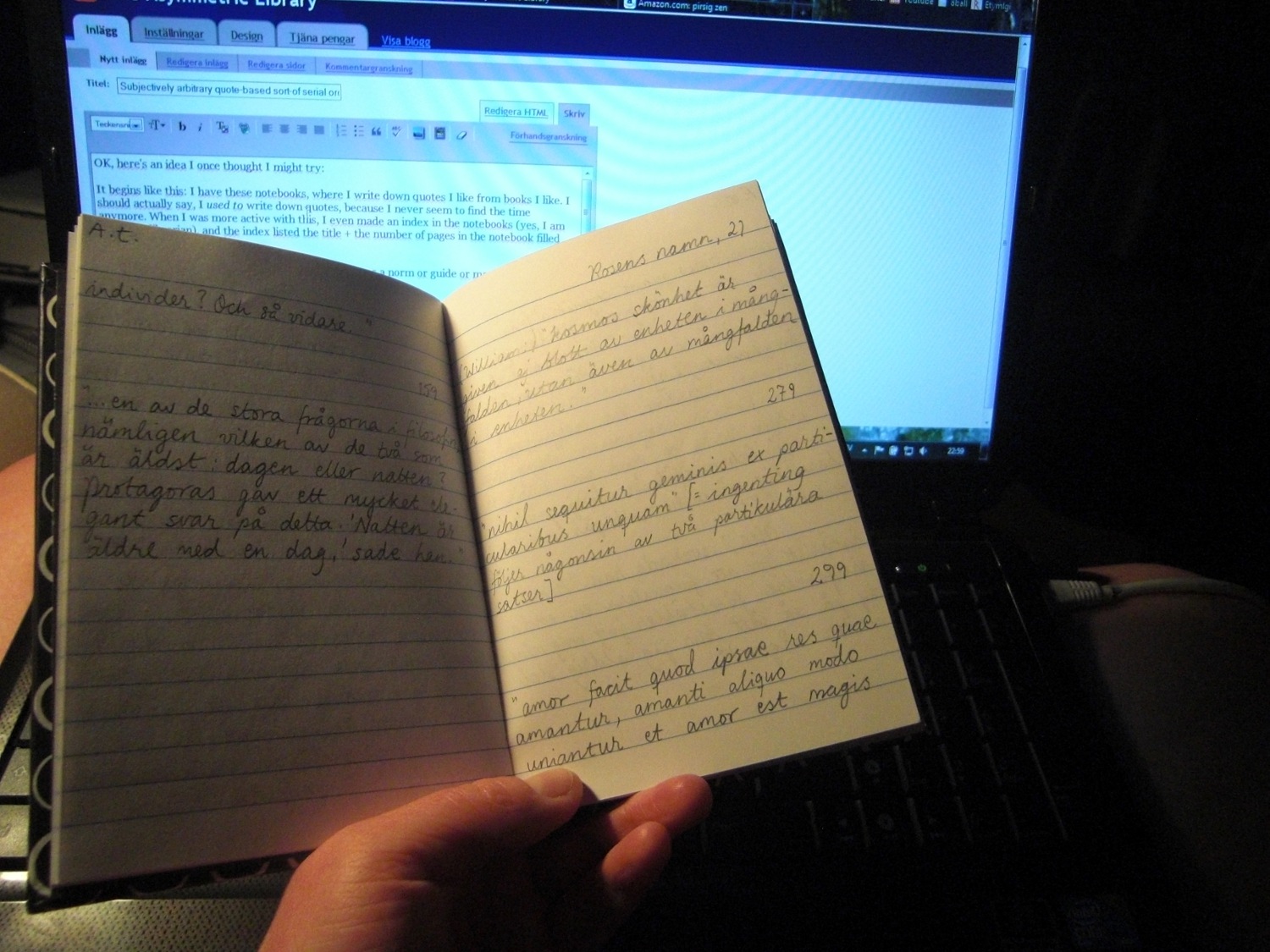 An example: The quotes from The Name of the Rose take up 3 pages in the notebook. Hence, I would put The Name of the Rose in its place after the previously quoted book, and next to it I would place two related books. Related how, you ask? I dunno. Other Eco books? Other novels centered round libraries? Other mysteries solved by monks?
It would have been interesting to find out, wouldn't it? But the system falls on at least two factors:
* I haven't written down quotes in the notebooks for ages. As I say, I can't seem to find the time.
* I don't own most of the books I've quoted in the notebooks. I was an avid library patron in those days (now I want to own! my books), and most of the quoted tomes are back in Hc, Hce and He shelves in libraries around Sweden. I don't even own The Name of the Rose, in point of fact...
onsdag 23 juni 2010
Serially alphabetically
In one of the comments here I found this amazing idea:
* When you've done half the bookshelf, you're bound to run into problems like "having no more titles that end in an 'M'", and you'll have to shift it around so that titles that end with an 'M' are followed by titles that end in a more common (or do I mean rare?) letter. And even then, there will be books left in the end that just don't fit in.
* New books! You can only ever buy books where the title begins with the last letter of the last book in your bookshelf.
... or something.
But I like the serial idea ...
once for fun, I took all my books off a shelf and arranged them alphabetically with a twist. I chose a first book at random and the next book's title had to start (excluding a and the) with the last letter of the previous book's title (excluding a and the) and so on. I managed to get all but 15 of the books to fit in this scheme.This is quite tempting! But there are a few practical cons:
* When you've done half the bookshelf, you're bound to run into problems like "having no more titles that end in an 'M'", and you'll have to shift it around so that titles that end with an 'M' are followed by titles that end in a more common (or do I mean rare?) letter. And even then, there will be books left in the end that just don't fit in.
* New books! You can only ever buy books where the title begins with the last letter of the last book in your bookshelf.
... or something.
But I like the serial idea ...
tisdag 15 juni 2010
Adaptations
One system I have at the moment, on a shelf apart from the big bookshelf, is a shelf for adaptations:
 Primarily, it's the book and then the movie / tv series based on the book. But there are a couple of exceptions... Men in Tights and The Outlaws of Sherwood are both different interpretations of the Robin Hood myth - and since this picture was taken, I've put my Arthur Conan Doyle collection and Sherlock Holmes with Robert Downey Jr. in the shelf. Inkspell and Inkdeath haven't been made into movies, but I put them with Inkheart and Inkheart in the hope that they may yet be... And in the case of Neverwhere of course, the book is based on the tv series.
I'm thinking of a way of expanding this: adding books that are adaptations / interpretations of other books. The Odyssey with Ulysses, Strändernas svall (Return to Ithaca) and The Penelopiad. The Jungle Books with The Graveyard Book. Treasure Island with Lighthousekeeping. Alice in Wonderland with Tom Waits' Alice and Alice in the Country of Hearts. The Wizard of Oz with Wicked... when I've read Wicked. And so on.
This could probably go hand in hand with the intertextual system I pondered here. But I wonder where I'd place Jasper Fforde. I'd probably be needing that every book next to all other books system.
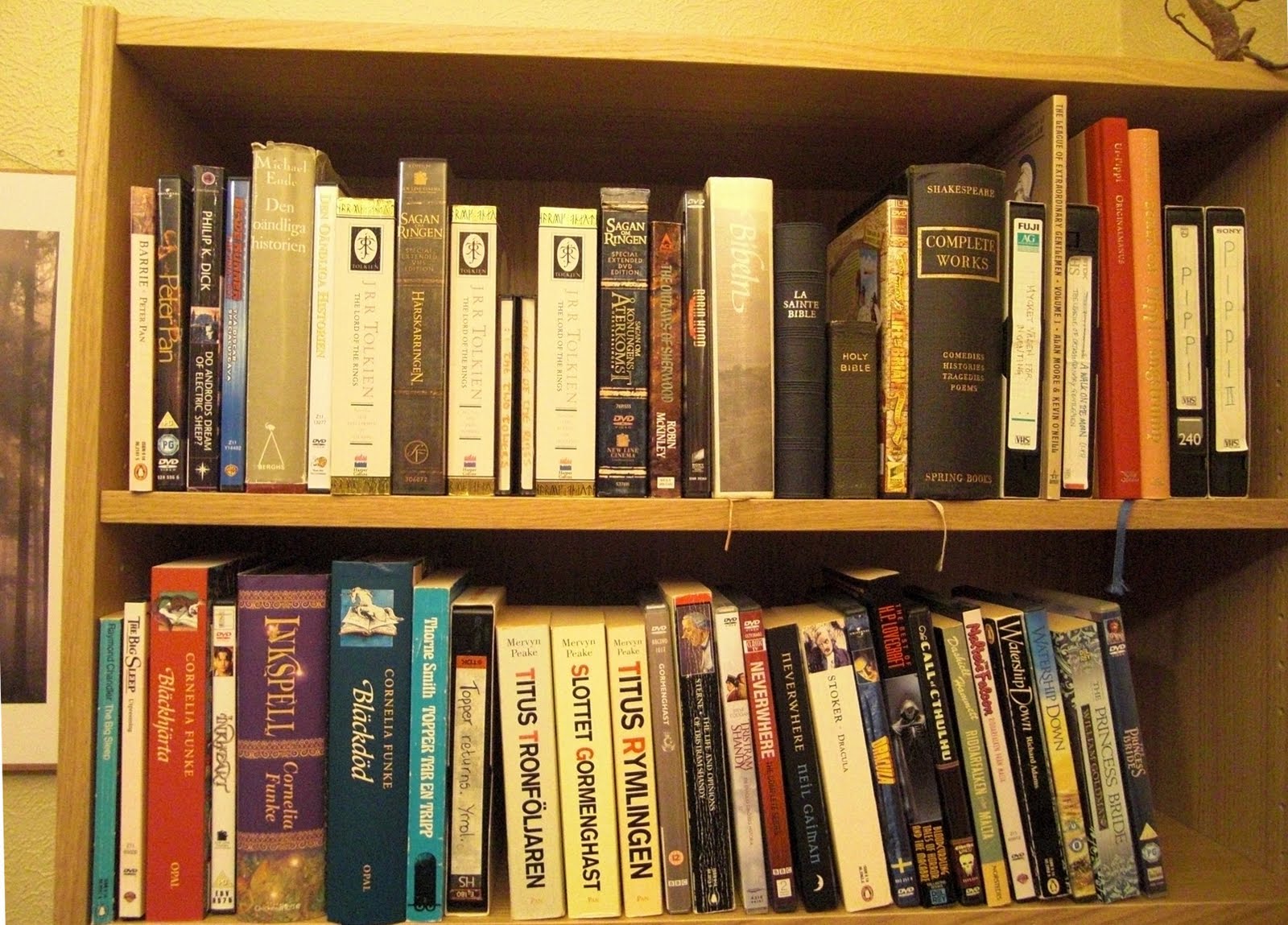 Primarily, it's the book and then the movie / tv series based on the book. But there are a couple of exceptions... Men in Tights and The Outlaws of Sherwood are both different interpretations of the Robin Hood myth - and since this picture was taken, I've put my Arthur Conan Doyle collection and Sherlock Holmes with Robert Downey Jr. in the shelf. Inkspell and Inkdeath haven't been made into movies, but I put them with Inkheart and Inkheart in the hope that they may yet be... And in the case of Neverwhere of course, the book is based on the tv series.
I'm thinking of a way of expanding this: adding books that are adaptations / interpretations of other books. The Odyssey with Ulysses, Strändernas svall (Return to Ithaca) and The Penelopiad. The Jungle Books with The Graveyard Book. Treasure Island with Lighthousekeeping. Alice in Wonderland with Tom Waits' Alice and Alice in the Country of Hearts. The Wizard of Oz with Wicked... when I've read Wicked. And so on.
This could probably go hand in hand with the intertextual system I pondered here. But I wonder where I'd place Jasper Fforde. I'd probably be needing that every book next to all other books system.
söndag 13 juni 2010
Chronological orders
There are several different kinds of systems based on chronological order. Some are: By the author's birthday/age; By the year the book was written/published; By the order in which you bought/received the books; By the time in which the book is set.
1: By the author's birthday/age.
Complications:
* Books with two or more authors. But that should adhere to the general system: if you place your oldest authors first on your shelf, books with many authors should be ordered by the eldest - and vice versa.
* Authors with uncertain birthdays. And/or uncertain existence - like Homer.
* What do you mean: how old they were when they wrote the book, or how long ago they were born?!
Suborder: authors' books in order they were written.
Complication:
In the order they were written, or in the order they were published? These aren't always the same. Sub-complication if you choose the former: an author's old books are often extensively revised if they are published later in the author's career - is it the same book?
2. By the year the book was written/published.
Complication:
 The same as above: what to do about revisions, and books where there is a long time between writing and publication? I would vote for [publishing date for the version at hand]. Revising a book is a lot of work.
Footnote: by version I mean version of text. If the paperback has the same text as the hardback, I'd go by the hardback's publication date.
3. By the order in which you bought or were given the books.
Complication:
I don't remember!! Do you?! If this were to work, I would've had to begun the system when I owned five books, and continued at it from then on. I know which ones I've owned for a long time, and which ones are new, but... srsly?
4. By the time in which the book is set.
Quite a challenge when you think of it. Could be interesting. What to do about alternate history/alternate reality, and time travel, and weaving together threads in several times, and books with huge time spans?
Would perhaps require separating books set in our world from books set in other worlds. Or would it? Here's one version that has been suggested: If a fantasy book is set in the year 3089 in its own world, it comes after e.g. 2001. Books where no year is mentioned are ordered by the season in chapter one. (But: what comes first, the winter or the egg? The spring or the chicken?)
But it might work, if I were to think it all through... Hmm...
1: By the author's birthday/age.
Complications:
* Books with two or more authors.
 But that should adhere to the general system: if you place your oldest authors first on your shelf, books with many authors should be ordered by the eldest - and vice versa.
* Authors with uncertain birthdays. And/or uncertain existence - like Homer.
* What do you mean: how old they were when they wrote the book, or how long ago they were born?!
Suborder: authors' books in order they were written.
Complication:
In the order they were written, or in the order they were published? These aren't always the same. Sub-complication if you choose the former: an author's old books are often extensively revised if they are published later in the author's career - is it the same book?
2. By the year the book was written/published.
Complication:
 The same as above: what to do about revisions, and books where there is a long time between writing and publication? I would vote for [publishing date for the version at hand]. Revising a book is a lot of work.
Footnote: by version I mean version of text. If the paperback has the same text as the hardback, I'd go by the hardback's publication date.
3. By the order in which you bought or were given the books.
Complication:
I don't remember!! Do you?! If this were to work, I would've had to begun the system when I owned five books, and continued at it from then on. I know which ones I've owned for a long time, and which ones are new, but... srsly?
4. By the time in which the book is set.
Quite a challenge when you think of it. Could be interesting.
 What to do about alternate history/alternate reality, and time travel, and weaving together threads in several times, and books with huge time spans?
Would perhaps require separating books set in our world from books set in other worlds. Or would it? Here's one version that has been suggested: If a fantasy book is set in the year 3089 in its own world, it comes after e.g. 2001. Books where no year is mentioned are ordered by the season in chapter one. (But: what comes first, the winter or the egg? The spring or the chicken?)
But it might work, if I were to think it all through... Hmm...
A quote,
or rather, a paraphrase. In The Library at Night (I read it in Swedish, Nattens bibliotek), Alberto Manguel writes about libraries. When he writes about how his own private library is organized, he mentions that visitors might think it arbitrary and ask,
 This strikes a chord with me. It makes me want to sort all my Keats, Byron and Shelley books together - not only their poetry but also The Stress of Her Regard, Fevre Dream, The vampyre and The difference engine. And then of course the Shakespeariana (e.g. The Stratford Man, Something rotten, Wyrd sisters & Lords and ladies) next to Will's plays.
And then the subtler connections: Dragons of Babel with L'Écume des Jours by way of Duke Ellington. The Steppenwolf with Goethe and Mozart. Firmin with Wuthering Heights and others of Firmin's favourite books. Matilda with Great Expectations. The Hitchhiker's Guide to the Galaxy with Foundation and Mostly Harmless with Have Space Suit - Will Travel. And so on and so on.
An intertextual bookshelf. It would need to be in many more than three dimensions.
"Why sort both my paperbacks of Chapman's Homer under Keats?"
 This strikes a chord with me. It makes me want to sort all my Keats, Byron and Shelley books together - not only their poetry but also The Stress of Her Regard, Fevre Dream, The vampyre and The difference engine. And then of course the Shakespeariana (e.g. The Stratford Man, Something rotten, Wyrd sisters & Lords and ladies) next to Will's plays.
And then the subtler connections: Dragons of Babel with L'Écume des Jours by way of Duke Ellington. The Steppenwolf with Goethe and Mozart. Firmin with Wuthering Heights and others of Firmin's favourite books. Matilda with Great Expectations. The Hitchhiker's Guide to the Galaxy with Foundation and Mostly Harmless with Have Space Suit - Will Travel. And so on and so on.
An intertextual bookshelf. It would need to be in many more than three dimensions.
Prenumerera på:
Inlägg (Atom)